



THE MISERABLE MOTHER
THE MISERABLE MOTHER
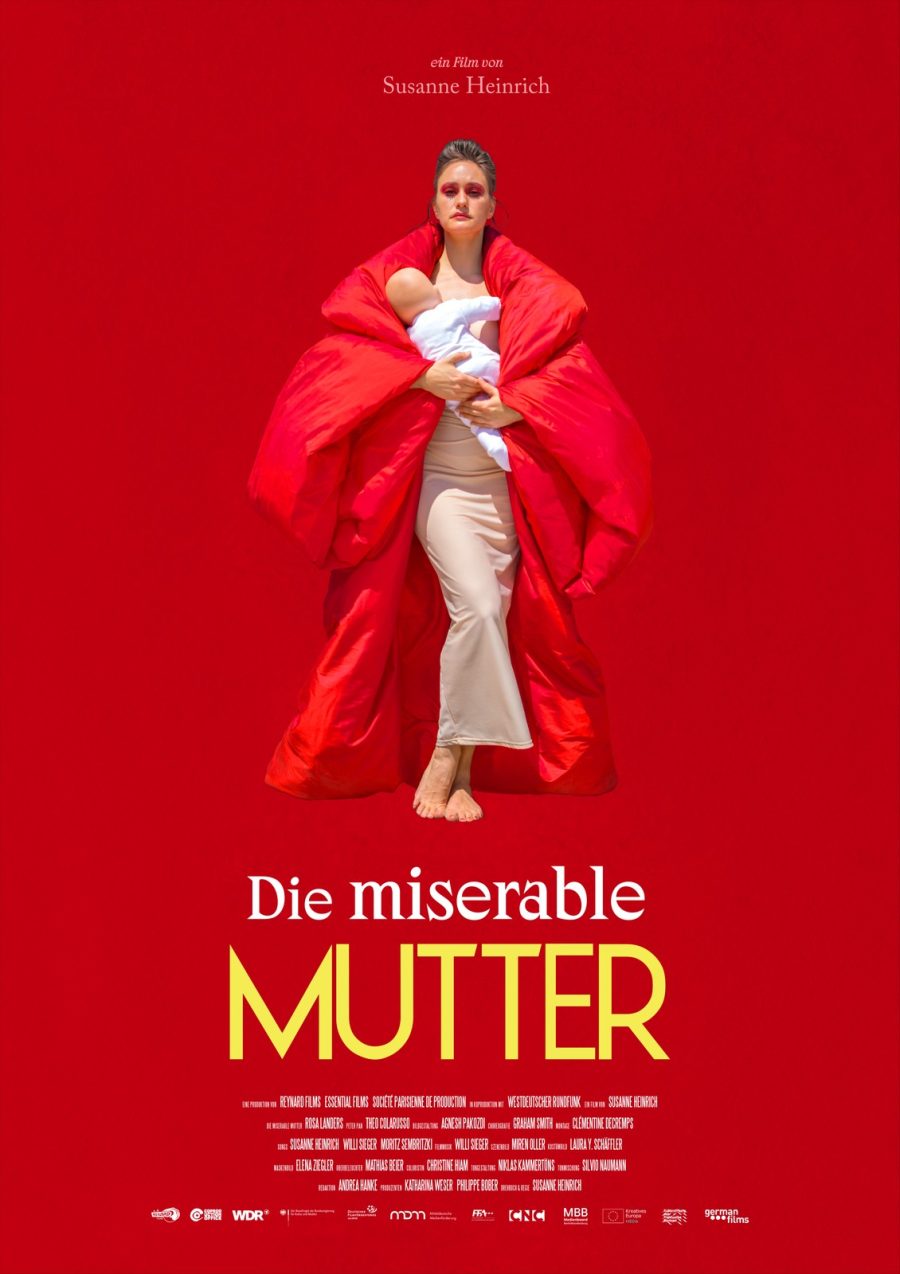
Close-up: The Miserable Mother with her child stands before a painting of the Madonna, which she almost perfectly replicates: the same pose, the same colors, the same sublime expression. The director’s voice from off-screen: “Head just a little bit to the left. And … action!”
Peter Pan scurries into the frame. He showers The Miserable Mother’s face with kisses and distributes groceries -diapers, nursing pads-around the apartment, turns on the dishwasher, and casually catches The Miserable Mother, who only stands up to fall asleep while standing, as he walks by: a choreographed relationship dynamic. Bodies that never come to rest, that are constantly in motion, on the move, not toward one another, but from pose to pose.
So it is in the next scene: The Miserable Mother strides through the park with a stroller and a gait that expresses nothing but suffering, muttering to herself in rhythm with the accompanying spinet: “Oh, if only I could at least work, if only I could write, if only I could at least read, if only I could think … Oh, you!”
On her daily walk through the geometric flower beds, she encounters an old acquaintance who immediately takes her to the mother-and-child café, introduces her to her new community. This community has an opinion on everything, a trendy term (“Mum shame!”), and some unsolicited advice. And immediately, to a beat made up of the sounds of folding strollers, diaper bags, and plastic tableware, they sing of their self-image as a community of necessity: “But no one warns you beforehand / No one tells you what it’s really like / So much for solidarity among women! / You must become a mom yourself / To find out what it’s like.”
Her own mother, who helps The Miserable Mother with either the dishes or the laundry, can’t make much of this kind of performative parenting. “If I’d spent my time worrying about that, I wouldn’t have got anything done” is her dry comment on the three-minute musical interlude about what kind of parents The Miserable Mother and Peter Pan actually want to be. And everywhere else -whether at a film screening or a protest in the park-The Miserable Mother feels like nothing but a misfit. Most of the time she sits on the couch anyway, where she has made herself at home, while Peter Pan flits around her, trying everything to keep her favor. The division of roles remains as static as The Miserable Mother’s position on the sofa. Or, in her own words: “You’re responsible for optimism, I’m responsible for the problems.”
But even this realization does not prevent the dilemma from unfolding further instead of a conflict. This dilemma concerns a mother who has always been miserable and a Peter Pan who can’t do anything right, and revolves around the question of whether it still makes sense to stay in light of this situation. When the inevitable happens and Peter Pan finally leaves after all, it’s not as if everything is finally over. It simply goes on, “the program that all young parents go through” and which even these two, despite all their wisdom and good intentions, cannot escape. Or can they?
What could be a sad, run-of-the-mill story about young parents in the 21st century is, fortunately, a musical with fairies, talking babies, and a children’s choir in heaven. Because in the end, it’s perhaps not so much about motherhood, but rather about absurd social conditions, which are perhaps best captured through children’s melodies and comic-book aesthetics. And just a little bit about the question of who we’re actually doing all this for.
Cast: Rosa Landers, Theo Colarusso
Director: Susanne Heinrich
Writer: Susanne Heinrich
Cinematographer: Agnesh Pakozdi
Editor: Clémentine Decremps
Choreography: Graham Smith
Songs: Susanne Heinrich, Willi Sieger, Moritz Sembritzki
Original Score: Willi Sieger
Production Designer: Miren Oller
Costume Designer: Laura Y. Schäffler
Make-up & Hair: Elena Ziegler
Sound Design: Niklas Kammertöns
Produced by: Reynard Films – Katharina Weser, Essential Films – Philippe Bober, Société Parisienne de Production
In coproduction with: WDR – Andrea Hanke